Webcomics have always had trouble making money, and I'm not even talking about a living wage. Not even minimum wage. Just a little something to offset a hobby and pay for some materials. Only the really popular comics can do it — the pop culture sensations — can actually create a living for their creators. Most people have given up trying.
The best solution to this problem was given by Scott McCloud in his book Reinventing Comics. He suggested a micropayment system where readers would pay a small amount – a couple of cents to a dollar, say – for creative content from the web, whether novels, comics, music or movies. Among even a few hundred readers, a couple of cents would offset costs for the webcomic artist beautifully.
In the comic continuation of Reinventing Comics titled I Can't Stop Thinking, Scott McCloud compares music downloads to webcomics in his arguments for the viability of micropayments. His points are all excellent ones, but they are concerned with why it should work — why people should be willing to pay their loose change towards a comic they like. That's not really important. That's simply gospel, convincing people of an idea. We don't need convincing. We don't want to know why it should work, we want to know how it can.
Because in the seven years since Reinventing Comics, micropayments have gone nowhere at all.
Scott McCloud himself had the only comic I'm aware of that used the system and even he has recently abandoned the idea of micropayments for it. The artists don't want to risk losing their readers and the readers seem to have no interest at all in paying even a small amount of money for something they're used to getting for free. Hah! It'd be like people flocking to a service that sells music for, oh, I dunno, ninety-nine cents when they could just download it for free over on the file sharing networks.
Ridiculous.
iTunes versus Webcomics
"We wanted to sell a million songs in the first six months. We did it in a week." – Steve Jobs, CEO of Apple, 2003
In the same period it took for micropayments for webcomics to go from a great idea to… still just a great idea, the Apple iTunes Music Store has been selling creative content for small amounts of money when the same content is available for free elsewhere. It has managed to sell over two and a half billion songs, captured 80% of the online music market and is now the fourth largest music retailer in the United States along side stores like Walmart and Target. It did this whilst constantly competing against free music download services such as Napster, Kazaa, Grokster, Limewire and eDonkey, against CD retailers, and against other online music stores who got in first, such as Rhapsody and Pressplay.
Eighty percent. In any other market, a 30% share is a resounding victory. 80% is just flabbergasting. There were no special circumstances. They weren't first, or cheapest, or a monopoly. Sure, the iTunes Music Store worked seamlessly with the iPod but it's not like people couldn't still use ripped CDs and illegally downloaded music on it as well. They had staggering amounts of determined competitors on every possible level, much of it backed by the record industry powerhouses themselves. It really is ridiculous. It's absurd, impossible and unheard of. Yet it worked.
So… why not for webcomics? The parallels are still there and the markets are still very much the same. In both cases, there is free content available on the web that the creators would like to encourage people to pay a small and quite reasonable amount for. The only difference now is that Apple is making hundreds of millions of dollars off micropayments and webcomics are not.
So, why exactly can Apple do it and we can't? Why is iTunes so successful and the greater bulk of the webcomic community still unable to make a buck? Why are people willing to pay their loose change towards music but not their comics?
Let's dissect an Apple.
But first…
Before we do so, there are some important differences between the music and webcomic markets that we have to be aware of and allow for as we proceed.
One, free music downloads are illegal whereas free webcomics are normal business. This is important because the customer has certain expectations. Whether they download songs illegally or not, the customers understand that music is something you should normally pay for. However, they don't have this expectation of webcomics. This leads on to the next point…
Two, webcomic creators are generally not prepared to risk losing readers. Slam a toll gate down on a webcomic and your readership will plummet. To make this work, then, we must eliminate this problem.
Three, webcomic creators generally treat it as a hobby. They don't expect to get rich, or even usually make a living, but they feel it's fair to get something back. Okay, this is a broad generalization, but due to points one and two, I think earning a living would be difficult for the time being. For now, then, we'll concentrate on just making more money rather than a making a lot of it.
Four, webcomic creators do not have the resources of Apple. Our solution needs to be as easy and straightforward to implement as possible.
Right, with those firmly in mind, let's look at our two markets side by side and work out what, exactly, is going on here.
Micropayments
"(With Pressplay and Rhapsody) You can't just go get a song and pay a little." – Steve Jobs, 2003
Micropayments don't make selling creative content online successful. They never did, as Apple clearly understood. All they do – the only thing they do – is make it viable.
Advocates of micropayments for webcomics seem to be expecting it to "just work" to borrow an Apple phrase. They focus on the low cost, assuming that a handful of cents for a worthwhile comic is great value for money, so people should be willing to pay, right? They forget, however, that no matter how little they ask for, anything over zero is a price hike. It doesn't matter if you think it's a fair and reasonable price, or even if you think it's dead cheap and way too low – consumers are not going to spend money because of their sense of fair play. The only people who will are other comic creators, which is hardly the point here.
And after expecting micropayments to "just work" and seeing that they didn't, webcomic creators became not only disenchanted with the idea of micropayments but also with the possibility of ever having a fair market at all. It is far more common now to hear that micropayments "just don't work" — that the entire premise is flawed and that consumers will never pay for something that they're used to getting for free.
It never occurred to anyone to look somewhere else for the problem. It's like trying to find your glasses when they're on your nose. In fact, it has nothing to do with micropayments at all. The flaw in the market isn't the price, it's the market itself.
Services and Subscriptions
"The subscription model has failed so far. Customers don't seem to be interested in it" – Steve Jobs, 2007
Webcomics are currently treated like a service rather than a product. You don't get to keep the comic but rather you get access to it. The creator controls that access and can turn it off at any time. Any money they do make is generally through advertising. It's like how free-to-air television and radio work.
Micropayments as Scott McCloud pitches them don't change this but simply add a small charge for the access, turning it into a subscription model. Other non-micropayment subscription services such as Modern Tales, WirePop and others work more like cable television. They cost more but you get access to an entire catalogue of comics (whether you happen to want to read them or not).
Unfortunately, subscriptions for creative content don't really work. They actually never have. They only work when the companies that provide the subscription service also have a stranglehold on the product and its distribution so you simply can't get the product any other way. Television functions like this and the networks have only recently started feeling the ground shift beneath them thanks to DVD, iTunes and file sharing services. Cinema keeps their stranglehold on films for a short time by delaying the release of DVDs until after the theatrical run and other performance art – theatre, opera and so on – simply don't work as well on DVD anyway.
And that's it. There are no other subscription models around and the ones we have are all firmly regulated so that, at least for a time, you have no option but to pay for them as a service rather than a product.
In fact, treating a product as a service doesn't even work well when it's free. There are three bookstores in my local town and only one library and the people in each bookstore reliably outnumber those in the library. What's up with that? At the library the books cost nothing. Why is it that even free subscriptions simply don't work in an open market?
Well, how much music do you own, safely on your hard drive or on CDs? How many books and comics do you have?
Now… How many do you rent?
Anyone?
What's wrong with subscriptions is that, no matter how little you charge for them, they don't give people what they want, because what they want is to own it.
Ownership
"The experiment's been run. People don't want to rent their music." – Steve Jobs, 2004
When iTunes hit the web, it had two main online competitors called Rhapsody and Pressplay, both of which were subscription services. You payed monthly and listened to any music you wanted. If you stopped paying, your music would stop working. Fzzt.
And they didn't just fail, they never even got up any speed. They weren't doing well even before iTunes came along. Not even remotely. No one was interested in paying for something and not having it to own. They would rather go out and buy a CD – or download it illegally – and get to keep the music.
The paid subscriptions in the webcomic world are a little friendlier since you can always access the most recent comic and can read the first chapter or so as a taster. Still, subscriptions remain a very poor option. The user has to pay for something he normally expects for free and receives nothing permanent in exchange. Oh, you can download the comics to your hard drive one image at a time if you can be bothered spending a few dull and repetitive hours doing so, but you'd have to be quite a fan to think that was anything like a good trade.
And yet… people do this. Those with a little programming know how write automated scripts to do the work for them but others will download hundreds of images by hand if they must.
If people want something then they want to own it. They want control over it so that the product can't be snatched away if they stop paying. This is especially important for webcomics because they do sometimes simply vanish from the web.
To make money, webcomics need to offer the readers something they get to keep.
Ah, but webcomic writers already do, don't they? Many have a voluntary donation scheme which, although doesn't go quite as low as a couple of cents, is basically a micropayment system. Make just a dollar donation and you'll often get a reward for your money. You get… a sketch. Or some wallpaper.
Whee.
Target Audience
"Music's a part of everyone's life. Everyone." – Steve Jobs, 2001
Merchandise, such as wallpapers and sketches, is aimed at entirely the wrong target audience. It's like getting a free poster with a CD. Yeah, it's nice to have a quick look at but few people are actually going to hang it up. They're generally more interested in the actual music and are just as likely to throw the poster away. It doesn't make the experience better or easier. There's no improvement in what you care about, just a freebie that you don't much want. You'd have to be a real fan to actually want it
In an article about fans and feedback, I worked out that the true fans of a webcomic amount to just two percent of the total readership. Justin Pixler (creator of the webcomic Masters of the Art) has since worked it out separately at three percent. We'll err on the side of caution and use his figure.
These three percent are the people who will comment in tag boards, sign up for forums and send fan mail. They're the ones who care deeply about the comic and will buy merchandise either because they care enough to want it or because they think the comic creator deserves some payment. They're also the ones who will buy subscriptions should you have them.
And pretty much anything would have roughly the same percentages attached. I have the entire Lord of the Rings trilogy on DVD, for example, but I don't have any painted figurines, replica swords or even a poster. I have a friend with a block mounted poster but he got it for free. He wouldn't have it otherwise. The consumers are legion but the fans are few.
And by selling T-shirts, wallpapers, mugs, posters, badges and prints, webcomic creators are targeting their sales at the fans – at just three percent of the possible market. That's like opening a music shop that sells only Glam Rock. It doesn't matter how cheap you can sell the music – you need more customers than you're going to get. For a webcomic to make a reasonable amount of money, they need that other ninety-seven percent. We need to stop targeting our products at the fans and start targeting them at the readers.
What product can we sell for a handful of loose change that all the readers, not just the fans, will want to own?
The Product
"This is how we competed with piracy. We offered a better product." – Steve Jobs, 2004
In order for the greater bulk of a webcomic's audience to pay their money, you must offer them something that they want for that money. So, what do they want? There is only one thing that you know, absolutely and for a fact that every reader of your comic wants. They want to read the comic.
I've already said we won't be messing with the freely available comic on the website – that's a sure way of dropping your readership down to the three percent of fans only. This leaves two immediately obvious things that we can offer them, both of which don't work well in practice.
First, we can sell them a book, as lots of webcomics do. Books are inconvenient, however, slow to arrive and expensive to buy. They're certainly not in the magic micropayment range we want.
The second idea is to make a separate chapter of the comic and make it exclusively available in exchange for donations. This is a better idea which would probably work well if the price was suitably low. However, it's a lot of effort to make the extra comics and most webcomic creators don't have that sort of time.
No, instead we'll take the third option and do exactly what iTunes did. We're going to sell our creative content for money while it's still online for free.
How to perform this clearly impossible feat is the exact same problem faced by Apple and iTunes. The fanatical faithful – of which Apple has plenty – would spend their money as always, but that's not enough. However, everyone else can already get the content for free. How could Apple possibly make them buy it as well?
Convenience
"(Downloading music) offers users near instant gratification, at least compared to going down to the record store." – Steve Jobs, 2003
Convenience is a huge advantage of both illegal and legal music downloads. You don't have to grab your keys and wallet, put some shoes on, drive to the shop, buy the music and drive home. You also don't have to then rip the music to listen to it on the computer or on your portable music player of choice. iTunes and the file sharing networks are much easier. Click. Wait five minutes. Done. It's yours.
For book versions of comics, the actual purchasing is fairly easy but there's a long delay, extra money for postage and a bunch of other hassles. It's even less convenient than going to the shop and it is a huge turn off to all but that three percent of pureblood fans.
So, the obvious solution is to do as iTunes does and deliver the comic as a download. We could allow people who make donations to download a chunk of the comic all at once – a chapter, or a few chapters to make a sort of trade paperback, or even just the previous year's worth of comic. They pay their loose change in order to quickly and easily download the comic to keep for themselves.
But, really, why would they? Is ownership and convenience enough?
Absolutely. You only have to look at the gigabytes of media most people have saved on their hard drives to know that ownership's a really big deal. However, it wasn't enough for iTunes, not with the file sharing services also offering ownership at no cost. Apple couldn't just match them, they had to beat them. They had to offer better value for money than the file sharing services – better value for money, in fact, than a free product.
Value for Money
"We're going to fight illegal downloading by competing with it." – Steve Jobs, 2003
Offering something for free is not the same thing as giving value for money. Apple offers a massive amount of value for money across all its products and services. Webcomics, on the other hand, might offer a great deal of free content but not much value for money.
Sounds a bit contradictory, doesn't it? It's very important to define terms here. I don't mean to give them something desirable. I'm sure you're trying your best to make your webcomic as good as possible already. Value for money is different. That's not about giving people something new or something impressive – but rather giving them something that enhances what they already want or already have. Something that completes the experience.
There are two main ways of doing this but they often overlap some.
The first way of offering value for money is to provide, free of charge, ways to reduce or eliminate the inherent disadvantages. One disadvantage of downloading music is the lack of cover art, so iTunes supplies it, giving them an edge over file sharing. Similarly, one disadvantage of using an Apple computer is that it starts out unfamiliar to anyone used to Windows, so they offer training and advice free in the Apple stores.
The second way is to enhance the experience – to take what you have already bought and make it better. Apple computers come with a built in webcamera, for example, as well as a suite of excellent software for managing your media – photos, music, videos and so on. iTunes is not only an online store but a powerful, easy to use music management program with an instantaneous search. Both these things add value to the product.
In both cases, it's important to focus on what the customer wants out of the product and make it better at doing that. Computer companies like Dell and Gateway include "free" software but generally throw on whatever software they're paid to include by other companies. The quality is low and most of it is probably irrelevant at best and annoying at worst. It doesn't enhance anything, let alone what the user actually wants out of the computer.
Webcomics have quite a few disadvantages which are waved away once you have the comic safely on your hard drive. Firstly, cycling through comics online is slow. Even on the fastest broadband, there's a momentary delay as the signal whizzes over to where the comic is and then whizzes back again – something it has to do for every single image on the website. If we allow the users to download to their hard drive, that's all gone.
The second problem is the clutter. Advertising banners, tag boards, voting buttons, newsboxes… It all gets in the way, crowds the comic and almost always means you have to scroll to see it. Even the comic's title is a problem. On a webpage you have to advertise who you are, but if the comic is downloaded to someone's hard drive, they already know. The title can then be much smaller and less intrusive – or even taken out completely and replaced with a cover page at the beginning.
The second part of value for money involves enhancing the experience. That's easy enough. You simply make the comics larger and higher quality, maybe even colour them if they're not already and if you have the time. This downloadable version of your comic then becomes faster, better quality, higher resolution and with far less visual clutter than the online one. This all combines to make the user interface – the webpage – more attractive, more responsive and more pleasant to use. It appeals to all your readers, not just the fans, and they get to own the comic to boot.
Worth paying a buck for?
iTunes music is available for free off the filesharing networks but iTunes offers good quality music which is convenient, reliable and cheap. They provide cover art, allow you to use the music in presentations and home movies, and provide an easy yet powerful user interface for managing, navigating through and listening to it. Unlike the subscription efforts of their quickly dispatched competition, the user gets to own the music to boot.
Worth paying a buck for?
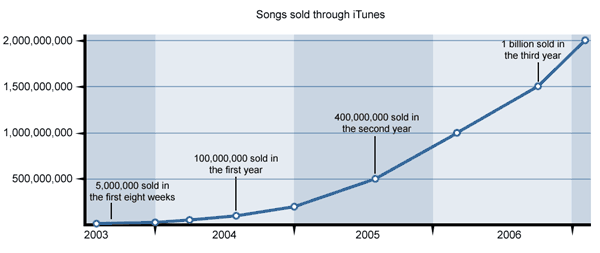
Two billion times over.
But Will it Work?
"There's no legal alternative that's worth beans." – Steve Jobs, 2003
As ideas go, it sounds too simple, maybe even simplistic, but there are lots of little reasons why it should work and six huge ones why it will.
One: It already has. Apple has used this strategy to not only beat every single one of its dozens of online competitors but also all but three of the companies who sell CDs in stores as well. They shot up from being nothing to the dominant force in the industry, making hundreds of millions of dollars in the process.
Two: Get a calculator and do the math and you'll find that by offering a product to the readers instead of the 3% that are true fans, we increase our potential customer base by a staggering three thousand percent. Will the income go up by the same amount? Heavens, no, but it will go up. You cannot offer a product to thirty times more people and not see an increase in sales. Clearly the more people a product is made for, the more of that product you're going to sell.
Three: Being able to own something is a really big deal to consumers. iTunes has proven this, as have illegal music downloads. VHS movies were locked into rentals for a decade and DVDs of television shows were a long time coming due to the stubbornness and paranoia of the networks, but now bought copies of movies and TV shows are where most of the profit is. We have file sharing networks, software that lets you download streaming media and thirteen separate plugins for the Firefox web browser that allow you to download and keep YouTube videos. People want to keep this stuff.
Four: It's better. The quality is higher, the user interface easier and navigation faster and more responsive. If you want to re-read an issue or chapter on the web, that's thirty or more pages to load and thirty or more adverts to scroll past. None of this is a problem once the comic's on your hard drive.
Five: There's no competition. The illegal file sharing services have many of the same advantages as iTunes, being quick, convenient and letting the user own the music. With webcomics, though, users can only download the images painstakingly by hand or buy an expensive book which will take ages to arrive. Webcomics have no viable competition that offer either convenience or ownership.
Six: Like Apple's foray into online music, the risk here is intentionally very, very low. There's some effort involved but not a great deal. You simply need to create larger, better quality versions of the comics with a simpler, cleaner navigation interface. Photoshop will even create the better versions for you with a batch action, meaning you need only do it once and then have a cup of coffee while Photoshop cycles through the rest. The entire process would take most people a couple of days and a week at most – nothing like the preparation involved with making a book.
And, just think… What if it works?
One more thing…
Starline X Hodge, writer and artist of Candi, and Ryuko, writer and artist of The Green Avenger, have graciously consented to be my guinea pigs for a test run. Hodge has been offering a book's worth of high quality versions of her comic for readers to download since the beginning of April and Ryuko will be starting a similar download offering this month.
I'd like to thank both artists for their help as the experience of setting up such a system was invaluable. Next month, I'll look at how they did as well as the specifics of how to successfully execute this idea – the formats, prices, image quality, files sizes and marketing considerations.

I don't understand why people have said that Joel is taking some sort of risk here. As far as I know, he doesn't even make a comic, or at least I didn't hear him mention implementing this for his comic (if he has one). He's simply asked others to test it for him, so they're the ones taking the risk, at his request.
By the way, one of the risk factors for this is that a lot of people just plain hate it when online comics try to make money in sneaky ways, and many people will also assume incorrectly that the regular comic is no longer free when they first hear the news on the site, which is very bad for business and can cause your readership to plummet.
As a participant in this, I think the main thing I'd like to add to the discussion is, that as an artist, the whole process didn't take up a lot of my time. And for me, this was the best part. Aside from the Keenspot check, the only way I usually made money from my comic was through donation wallpapers. I haven't had time on my hands to make a new wallpaper for the last 3 months, let alone try and come up with other merch like books and tshirts. So its nice to see a little cash come in through this when I don't have any time to do anything but work on the comic itself.
[quote=Bobby Crosby]
He's simply asked others to test it for him, so they're the ones taking the risk, at his request.
By the way, one of the risk factors for this is that a lot of people just plain hate it when online comics try to make money in sneaky ways, and many people will also assume incorrectly that the regular comic is no longer free when they first hear the news on the site, which is very bad for business and can cause your readership to plummet.
[/quote]
I don't agree. Because the download version is in addition to the daily comic as a seperate option, I don't think there's any more risk to it than say, a link to wallpapers. "Candi", for example, has such links off to the side in the margin, and they don't interfere with reading the comic. Why should a link/icon/button to the downloadable collection be any different, unless someone was dippy enough to put a huge splash graphic on their homepage touting downloads?
Mooncity
Autumn Lake
Reversing the polarity of the neutron flow since 1976!
People are incredibly stupid, that's why. Without any reason to conceivably think so whatsoever, someone recently told me that they don't read one of my comics because they didn't want to pay to read it. The comic in question, and all of my comics, are totally free online, yet someone said they don't read it because they thought they had to pay for it. Just imagine how many more people would think this if I promoted the sale of the online strips for a price. Tons of people would briefly read about this and think, "Oh well, it was nice while it lasted and the creator has sold out and I guess I can't read this strip anymore," without even reading the full post about it probably, and they leave, never to return. Now they'll only read 17 comics online instead of 18 and they won't care enough to check it again. This obviously wouldn't be a high percentage of readers who do that, but some of them, certainly, possibly a significant number.
Just want to point out that I think it's perfectly fine to do it, since the risk involved is fairly low, but my main point was only that I don't think it can make a significant amount of money, as Joel says it would.
Full agreement. I'm a heavy webcomic fan, and I'll read upwards of 150 a night (depending on when the various ones update) and there's over 200 in my bookmarks folder. (Plus I regularly trawl TWC and the Belfry for new ones.)
I've bought shirts, books and wallpapers, but I have never paid for a subscription, and probably never will. And considering how the Modern Tales subscription model hasn't exactly taken the webcomics world by storm, I strongly suspect I'm not alone in that.
Why should one assume that, if only 3% of fans will buy swag, that 100% of fans will pay a subscription? Strikes me more that only that same 3% or so can be counted on to pony up…
Doc.
http://www.the-whiteboard.com
Micropayments are a flat-out stupid way to try to make money from your comic. You cannot grow an audience by trying to sell material that people cannot read. (Yeah, yeah, "but I can put up sample chapters." Piss off. Most people who do that put their first — and worst — chapter up, or their latest — completely incomprehensible — chapter. Sure, that's gonna reel the readers in.)
Webcomics should be free, period. Do not try to make money from them. Make money from advertising (however negligible that amount of money is), make money from T-shirts or posters or other merch, and make money from print collections, but do not be stupid enough to try to make money from the comics themselves. NONE OF THESE THINGS ARE YOUR COMIC. Webcomics should be free, because the experience of reading 72 dpi comics on a computer monitor is simply not worth any amount of money, no matter how good your comic is.
Too many webcomickers have their priorities fucked up: Make a comic worth reading. Build your audience. And then worry about making money.
If you aren't making your comic simply because you enjoy doing it, stop. Just… stop.
I would like to offer my support for the ongoing discussion.
Joel, your article is well written and makes a number of great points. I see the analogy between the two forms of digital media and I recognize that you are determining the factors that make itunes successful and to bring that model-of-success to digital comics. Fantastic.
It's true that there are a number of other factors that make comics and music dissimilar and threaten to tear the analogy between digital comics and digital music apart.
There is a great benefit to sharing media for free. As mentioned previously, "fame" is garnered by spreading your comic (or music) to the most people that you can and charging a price may dissuade people from reading (or listening to) your craft. I would be very upset if I had to pay a quarter to turn on my radio to listen to music. I would also be upset if I had to pay a quarter to read through a number of comics.
Currently, the method of distribution for independent comics is through personal/individual websites (with archives) and not a comic station that circulates through a selected "playlist" of comics… where you would have to buy the comic that you want to read, at your convenience (on your portable iPad), as many times as you wish.
I know that there are independent musicians that are sharing their music for free on MySpace or having their videos on YouTube making waves in the industry as they get signed with a major labels after the free distribution. We have the same thing happening with our fellow webcartoonists as they get deals with Dark Horse, Image, and comic strip Syndicates. That appears to be where the money is at.
But, Joel, I don't read your article as a "get rich quick" guide to selling webcomics. I see it as a thoughtful interest in webcomics and allowing independent creators to be compensated for their passion and energy.
As far as speculating on what people would be willing to spend their money on: I can only speak for myself. I know that some people will buy merchandise where others won't. I know that some people will donate where others will not. Some people buy 24 page comic books where others buy collections. Some will buy in hardcover and others wait until it goes to paperback. The number of scenarios involved are many and varied and we have no control over it (which is bad for science).
In summary and with apologies, I'll be butchering Gordon's post in order to continue the music/comic analogy:
Once again, Gordon, I'm sorry.
-tony
Okay… good point, although I wouldn't equate 128 kbps MP3s with a high res PDF file. PDF files are stuck on the computer. You can copy an MP3 file anywhere.
Who told you that? A PDF is a file that can be copied like any other.
[quote=mooncity]"Candi", for example, has such links off to the side in the margin, and they don't interfere with reading the comic. Why should a link/icon/button to the downloadable collection be any different, unless someone was dippy enough to put a huge splash graphic on their homepage touting downloads?[/quote]
The problem with making it unobtrusive is you also make it invisible. If it's in a part of the page nobody looks at, who will know it's even an option?
But you have to READ them on a computer. Or do you have a color laser printer to read them properly, or a giant monitor in order to read a full page at a time without having to scroll up and down? I'm just saying that the PDF format is worthless to me, and to the vast majority of comics readers.
I can understand how the PDF format is worthless to you and to others (vast majority?) but I wonder if it's only because the current "delivery system" is not comparable to the iPod.
Technological advancements are about the "how to build a better mousetrap" model (in a way). Music has made the progress through recording from vinyl, to cassette players (and walkmen), to CD players (and discmen), to mp3 players (and the iPod). The advancements have made music portable and convenient.
With print, the advancements have been from Gutenberg's printing press to today's digital printing- where it's easier to make a book but haven't quite made a "better" book. You can read newspapers, comics, and books on your computer screen but it's not very portable or comfortable. I have a friend who reads CBR files on his Gateway convertible notebook (flipping it around so all you have is the screen) which makes it semi-portable (if you don't mind the weight) but not very convenient (in price).
I suppose the dream is the Gene Roddenberry universe where everyone is reading little handheld pads and old skool books are kept by collectors and eccentric lawyers. There may be people trying to bring this technology to the forefront- however we may need more "rockstar" authors to make reading popular in order to make this technology marketable.
-tony
I'm sorry I didn't find this discussion sooner, because tony's comment there about iPods was my very first thought. Micropayments for digital anthologies is a really exciting concept with a lot of potential, but unlike mp3s before iTunes, there is no prexisting niche for everyday use. Some people, possibly even many people, enjoy the use of illegal .cb* rips of printed comics, but the huge market potential just isn't there, and won't be until there are better and cheaper portable readers for the format.
Or until laser printers are cheap enough that people can buy them and print them out for less money than it costs to just buy a pre-printed magazine. (Black and white comics will likely be able to make in-roads in this department sooner than color, because of the cost factor.) Paper is more portable than any reader… at least until electronic paper technology improves…
I dunno. I may have spoken hastily before, but I think any real viability for electronic downloads of comics is a long ways off.