As you probably know, I've been expounding on a theory that sequential images can actually be called a language -- a visual language -- which emerges along with text in comics. In this article, I'm going to take a diversion from my usual heavy theory to look at some ways in which we can apply some of the ideas of visual language in practice.
Not all things from the verbal realm can apply to the visual. For instance, it would be very difficult (but not impossible) to have homophones in visual form (words that sound the same with different meanings). However, one area that is quite possible lies in rhyming.
As most everyone knows, rhyming is when the sounds of one word correspond to the sounds of another word or words: bear and pear; hat, mat, and bat; manga and conga.
While it might create a different feeling, we could hypothetically say that rhyming in the visual domain also establishes a correspondence between two different visual parts. Of course, the visual form can do this in many ways. On a small scale, rhyming is available to the contents of individual panels.
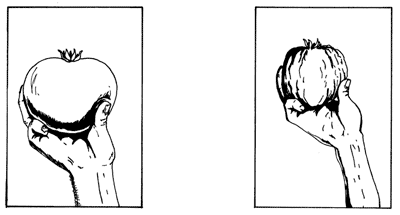
For example, these two panels are nearly identical, with only a slight change in them:
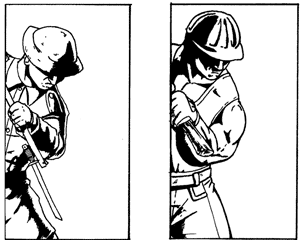
They aren't the same panel, but the change is enough that one might associate the content of one with the other. Essentially, this correspondence between the composition and content of images creates a visual rhyme. Here's another one:

In storytelling, visual rhyming creates interesting juxtapositions of content, like in panels that recur throughout a story with only slight changes. Visual rhyming can also create a smooth transition from one scene to another. For instance, shifting from an airport to an office using a panel of a plane propeller and a panel of a fan.
The visual form also allows for a type of rhyming that is unavailable to auditory poetry. This correspondence comes on a larger level of page layout. I would consider the following layouts to "rhyme" with each other on a large scale, along with the internal rhyming of some of the internal content:
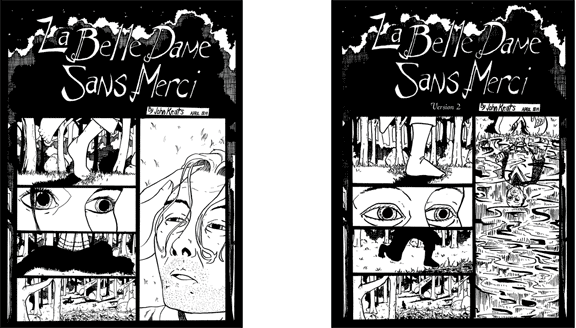
Of course, in order for this large-scale correspondence to work, the page layouts need to be novel enough to be distinct and recognized as such. For instance, three panel strips with square panels or six panel grids are not unique enough to evoke the recognition that rhyming takes place.
With layouts (and possibly image content), reverse rhyming is also possible. Here, the layout of one page is the exact reverse of another one. This technique was used quite famously in Alan Moore's Watchmen, to visually mimic the characteristics of a Rorschach test.
Theoretically speaking, rhyming isn't the most interesting of topics, and I can understand if people might want to quibble with the very idea of visual rhyming. However, we can put this theorizing to use in a variety of interesting and fun ways, like those discussed above. Or, we can borrow some contexts from verbal expression.
Naturally, rhyming of any sort doesn't truly become interesting until it's used in particular patterns. If random words strewn about in sentences just happen to rhyme, most of the time we don't notice it, but when its put into a particular pattern, then it becomes apparent.
Indeed, rhyming usually stays out of prose works, but for poetry it is often essential. Personally, I'm a big fan of writing poetry, especially traditional poetry with structure that needs to be followed. To me, showing your skill at working within boundaries is often even more impressive than breaking or making them up as you go. Being able to stick to the rhyming structure and meter of say a sonnet while saying something substantial demonstrates how skilled one's intuitions of the English language have been honed.
As far as I know though, no one has really established parameters like this for "visual language poetry." Some attempts have been made by people like Derik Badman to make visual language haiku and pantoum, but by and large no conventionalized tropes have been established. To me, this seems like a fertile and under-explored realm for experimentation, which I'll continue to explore in my next column.
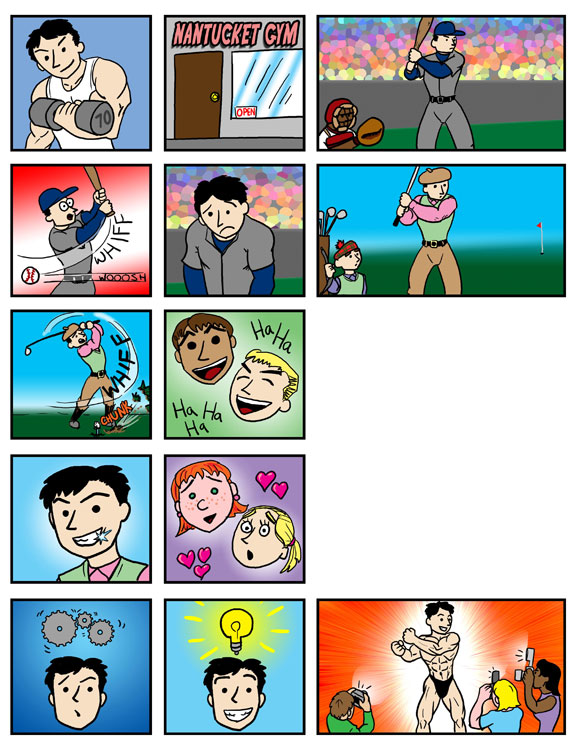
So, to get the ball rolling, I here offer a visual language poem in one of my favorite poetic styles (and encourage others to follow up with their own!). Care to guess what it is?
ComixTalk is not responsible for comments, blog and forum posts. News and ComixTalk Magazine articles are copyright by their respective authors.
ComixTalk, its websites and logos are ©2003-2008 | Managing Editor: Xaviar Xerexes | Site Design: Mind Faucet

Comments
Ayroles
Francois Ayroles' Jean Qui Rit, Jean Qui Pleure (John who laughs, John who cries) has a limited though interesting form of rhyme. He uses the almost exact image of the character John in groups of two panels, though in one he is happy and one he is sad. He is also in different context in each panel. There is a page example here:
http://coeurdepat.free.fr/Pattes/MainPage.php?num=5
This type of rhyming isn't something I've thought about too much, but I wonder if this kind of visual rhyme if really not the heart of how we can follow most comics from one panel to the next. Elements repeat in different ways so that we know we are seeing a next moment in time or another part of a scene (i.e. repeating characters, repeating backgroun elements).... Needs more though.
Rhyming and chorusing?
I'm sure I've butchered the definition, I can look up the interview, if you're interested. Also there's reference to it in his Wikipedia page:
Repetitions of certain lines in the stories' narratives (what Palahniuk refers to as "choruses") are one of the most common aspects of his writing style, found dispersed within most chapters of his novels. Palahniuk has said that there are also some choruses between novels; the color cornflower blue and the city of Missoula, Montana, are said to appear in all of his books.
This has pretty similar end result to the visual rhyming you've brought up here. And I've often thought about ways in which chorusing can be used in comics visually.
Great article as usual, Neil! The first two examples are especially striking.
Spiegelman used this in
The Yellow Light comics and stuff.
Interesting
Well, I think I see
The Yellow Light comics and stuff.
Seeing Alliteration
As we saw in movies like Ground Hogs Day or Memento, there's a sort of visiual alliteration that exists. It can easily be translated to sequential art.
Alliteration or rhyming in comics seem like a great way to set a precedence for deviation. In the same way you have a song in a major key, but you throw a 7th chord in there to accentuate a feeling. OK, I don't know what I'm talking about there, but you get my point?
Steve "Fabricari" Harrison

Rhythm versus Meaning
My concern with this idea of visual rhyme is that in textual poetry, rhyme is purely a rhythmic element--taken out of the context of the poem itself, rhymed words will have no obvious relationship to each other beyond their common sounds. By contrast, if you take the three "A" panels from your limerick piece, they are very clearly related even out of context. The similarity of the content of those panels implies meaning rather than rhythm, and are thus performing a very different function from that of rhyme.
On the other hand, I do think your use of layouts to imply a structured rhythm works well--remove all the content from your limerick, leaving only the layout, and I think the limerick form is still implied. I suspect more complex rhythmic structures are equally possible. I'm not sure if you're actively using panel size to approximate beats--if not, that's something else worth exploring.
What's in a name?
Whether you're calling it "rhyming" or "alliteration" for the visual form, I think it chalks up to the same thing. I don't really care what it's called in this context, but its a "correspondence of structure" that I'm after here (hence in the article I said "I can understand if people want to quibble...).
The rhyming aspects of verbal units that puts rhythmic things upfront and and meaning secondary is merely a matter of it being a symbolic relationship of form and meaning. The iconicity of visuals makes it hard to completely create an arbitrariness between corresponding elements (though I could imagine it being done).
In this context, this correspondence (pick what you call it) makes its impact due to structural positioning relative to other elements. Spreading similarly structured panels throughout a piece might create a theme or motif, though they don't give the same sort of contextual relationship of patterning within a sequence. We don't often see comics that use a structured AABAAB (or whatever) pattern (be it in content or layout). This sort of correspondence between images gives a way to think about that sort of thing at least. (I'll be exploring it more in the next column too).
------- Studying the Visual Language of "Comics" - www.emaki.net
------- Studying the Visual Language of "Comics" - http://www.emaki.net
I like the idea of the
The Yellow Light comics and stuff.
Awesome topic, which has
Awesome topic, which has occurred to me to some extent before, but the poetry analogy is a new one to me, and seems to be quite fitting. It would be interesting to see how this could be applied to/interpretted with comics like Dinosaur Comics, where the repetition is much less subtle, and an essential part of the strip.
I think some of my work can apply to the sort of concept you're talking about as well (pardon the self-referencing...I really hate doing this, but ocassionally it's actually relevant). I've been trying to play with similar structures across a "timeline" of sorts, with 'clickable' arrows in some strips showing something that's happened in the given character's past (examples: http://synch.toefur.com/007.html , http://synch.toefur.com/022.html)
-reva-
http://www.thinksynch.com
Reva,While I was reading
Reva,
While I was reading Neil's essay, your work came to mind immediately for me. Like you say, "poetry" isn't quite how I would have described your use, but the way you use repeated structures to mirror the rhythms of past and present is certainly related.
Reza, your use of that
Reza, your use of that flashback arrows is really cool and inventive. Don't feel bad plugging yourself, where better to do it than when it's contextual?Â
I realized that the final version of the article ended up cutting a line about the rhythmic patterns of layout that might be useful to share (curse my overediting!). Since layout can give a sense of rhythmic movement, it can act as a "visual meter," so that repetitive (or departing) layouts can use a metrical(-ish) pattern when used within a single work. Again, this can go towards establishing a patterned trope that can then be departed from.Â
-------
Studying the Visual Language of "Comics" - www.emaki.net
------- Studying the Visual Language of "Comics" - http://www.emaki.net
dinosaur comics reminds me
dinosaur comics reminds me of how in classical music sometimes a composer will do a series of 'variations on a theme', works with the same melody but with different cadence, chords, tempo, style, etc. i'm not sure how to relate that to poetry, though. maybe one of those exercises in creative writing classes where the teacher gives everyone the same word that their lines have to start and end with but they're still all totally different.
-------
and because no one else has guessed...
So, to get the ball rolling, I here offer a visual language poem in one of my favorite poetic styles (and encourage others to follow up with their own!). Care to guess what it is?
 Casey at the Bat in the form of a limerick?
-------
There once was a man from Nantucket
Heh heh lookit panel 2, it was too easy!
Steve "Fabricari" Harrison

Discovery
Well, you found me out... really I just wanted the whole message board to dissolve into limericks. (bonus points to those who can talk about theory in limerick form!)
-------
Studying the Visual Language of "Comics" - www.emaki.net
------- Studying the Visual Language of "Comics" - http://www.emaki.net
There once was a goose who drew comics
For inspiration he drank gin and tonic
But now he stays home
And write shitty poems
And jerks off to "Hooked on Phonics"
Yay!
Steve "Fabricari" Harrison

consider the dick and the fart
it's really the best source for art
if you give it a try
you'll soon find out why
your traffic spikes off of the chart
Steve "Fabricari" Harrison

WINNNAH AND CHAMPEEEN!
Man, if only traffic did
Man, if only traffic did spike off the chart.
Otherwise, true.
How crass.You, sir, have
The Yellow Light comics and stuff.
Man, if only traffic did
Rhyme as a Continuum
Another common type of rhyme is "eye" or "sight" rhyme -- where words are spelled (look) similarly but do not sound alike (the mind makes a connection nonetheless). There are also concrete or shape poems where the "rhyme" often equates to visual symmetry, parallel structure, or repeating patterns. ÂAm I the only one who was
Am I the only one who was happy to see the baseball player in the above comic finally find his place in the world?
Like the Rocky of the "example page" set.
Post new comment